AI can generate a video in seconds, making creating content faster than ever. But speed isn’t the same as impact, and faster doesn’t always mean better.
So what does “using AI in video” actually mean?
It’s not just about generating full clips from a prompt. In practice, using AI in video means that AI support appears throughout the entire process, from research and scripting to editing, captions, and post-production workflows.
The challenge can be that the same tools that provide efficiency and support can also strip away what makes video content feel real, making it harder to connect with the audience.
So how do you use AI without losing what actually connects?
After working with well-known brands across industries, we’ve seen where AI adds real value and where it can create problems. In this article, we’ll break down where AI fits into the video process, where it falls short, and how to use it to keep your content efficient, human, and effective.
The Evolution of AI in Video: From Text to Motion
Before we talk about when to use AI in video, it’s important to understand what it is and how it has developed.
Artificial Intelligence (AI) is the broader idea of building systems that can perform tasks normally associated with human intelligence, such as recognizing patterns, making predictions, understanding language, and solving problems. It focuses on analyzing data, spotting patterns, and making decisions. AI has been around for decades. The term was officially introduced in 1956 by computer scientist John McCarthy at the Dartmouth Conference, building on earlier ideas from Alan Turing about machine intelligence.
For many years, AI was mainly analytical. It helped researchers and companies solve practical problems, such as predicting the weather, filtering spam, and powering recommendation systems on platforms like Netflix and Amazon.
Generative AI came much later and changed how AI is used. Instead of just analyzing data, it creates new content, text, images, music, and video, based on what it has learned from large datasets.
Several breakthroughs helped make this possible. In 2014, Ian Goodfellow and his collaborators introduced Generative Adversarial Networks (GANs), which use two neural networks to generate increasingly realistic synthetic images. In 2017, researchers at Google introduced the Transformer architecture, which dramatically improved how AI systems process language, context, and relationships between pieces of information. Later, diffusion models became especially important for generating high-quality images and video from text prompts.
From there, progress accelerated quickly. Companies like OpenAI, Google DeepMind, Anthropic, and Runway pushed these systems further, leading to tools we now use every day. This includes Large Language Models (LLMs) like ChatGPT for text, and diffusion models like Midjourney and DALL·E for images.
Today, we are in the era of multimodal AI. These systems can handle and generate a wide range of content. These same systems are what power the latest wave of video generation tools, including Google Veo 3/3.1, OpenAI’s Sora/Sora 2, and Runway Gen-4, which are reshaping the video production landscape.
So why did this happen so fast?
The main reasons are demand, GPU/cloud compute speed, the availability of huge datasets, and social media content pressure. Video production has always been expensive and time-consuming. At the same time, social media created a constant need for content. This pushed developers to build tools that could make video faster and cheaper, reducing the need for full production setups.
While this made content creation more accessible, it also changed how brands think about quality, control, and long-term value.
How AI Is Changing the Video Production Process
AI video tools have improved significantly in a short time. If your last impression of AI video was distorted faces, broken hands, or glitchy motion, that’s now outdated. Today’s tools are far more advanced.
Here’s what AI can do right now.
1. Text-to-Video Generation
This is what most people think of when they hear “AI video.” To use this tool, you write a description, or what is now called a prompt, and it generates a video clip.
Tools like Seedance 2.0, Google Veo, Runway, and Kling are leading this space. Seedance 2.0, in particular, is one of the strongest right now. It follows prompts closely and handles things like motion, lighting, and physics surprisingly well. Compared to earlier video tools, the jump in quality is noticeable.
2. Script Research and Outlining
This is one of the most practical ways to use AI in video.
In the planning stage, tools like ChatGPT and Claude can help you move faster. You can use them to explore different angles, find gaps, draft rough outlines, and generate talking points tailored to your audience and goals.
These tools can allow you to get a solid first draft, instead of starting from scratch.
3. AI Avatars and Presenters
Ever wanted a person on screen without having to film them?
Tools like Synthesia and HeyGen can help you do this. All you have to do is write a script, pick an avatar, choose from over 120 languages, and the system generates the video for you. These tools are useful for companies that need to create content at scale.
For example, training videos, onboarding materials, or internal updates can be produced quickly without organizing shoots or hiring talent.
4. AI-Powered Editing
This is where AI is making the biggest difference in real production workflows.
Editing has always been time-consuming, especially when dealing with large amounts of footage.
With AI features like Generative Extend in Adobe Premiere Pro, which can expand a clip by generating extra frames that match the original shot, you can fix small mistakes without having to reshoot.
You can even use Descript, which turns video editing into text editing. You edit the transcript, and the video follows suit. It also removes filler words (“um,” “uh,” “like”) automatically, and can even regenerate audio in your voice so you can correct mistakes without re-recording.
5. Transcription and Captions
Transcription used to be slow and expensive. Now it’s almost instant.
Tools like Descript, Adobe Premiere’s Speech-to-Text, and ElevenLabs can turn hours of video into accurate text in minutes. Captions can be generated automatically, and even translated into multiple languages directly inside editing software.
This has made video content more accessible and easier to scale across different markets without needing separate teams for each language.
6. Voiceover and Audio
AI voice tools have reached a point where they’re actually usable in real projects.
ElevenLabs is one of the most advanced right now. It can generate natural-sounding voiceovers and even clone a voice from a short sample.
It allows you to fix mistakes, add lines, or create different language versions without bringing someone back into the studio.
It also includes audio cleanup features, such as removing background noise and improving the clarity of recordings that weren’t captured perfectly.
7. Storyboarding and Pre-Visualization
Before anything is filmed, there’s usually a lot of discussion about how things should look.
AI helps make that faster and clearer.
Tools like Nano Banana, Midjourney, DALL·E, and LTX Studio can generate visual references for scenes before production begins. You can show a client what a shot might look like, including lighting, mood, and framing, without building anything.
This reduces confusion early on and helps avoid costly changes later.
8. Music and Sound Design
AI can now generate background music based on a simple description.
Tools like Suno can create tracks in seconds. You describe the mood, style, and duration, and the system generates something usable and royalty-free.
For many types of content, especially social media or internal videos, this removes the need for expensive music licensing.
What Parts of Video Should NOT Involve AI?
AI is powerful, but it has clear limits. If you use it in the wrong place, you’ll risk losing your audience’s trust.
Here’s where AI should not be used.
1. Your On-Camera Spokesperson or Brand Face
Would you trust a company whose spokesperson was generated by software?
Your audience is quietly asking the same question.
A real person on camera communicates something beyond words, and that accountability is a form of trust. An AI avatar can deliver the same script, but it doesn’t carry the same weight.
At the same time, people aren’t entirely against AI. They understand there’s a time and place for it, especially when it adds efficiency or helps scale content. But when it comes to moments that require trust, credibility, and human connection, expectations shift.
A 2025 consumer study found that 95% of Americans have already encountered content that felt suspicious or AI-generated. People are paying attention, and they don’t easily forget when something feels off or inauthentic.
Understanding where AI fits and where it doesn’t is critical to maintaining trust. Check out this article to learn when to use AI without compromising your brand trust.
2. Customer Testimonials
A real customer is what makes testimonials work. When they talk earnestly about how your product helped them, laugh unexpectedly, or pause to find the right word, it feels relatable and makes the audience feel that they can trust them and your brand.
An AI-generated testimonial isn’t a testimonial. It’s a script dressed up to appear authentic. Your audience will know the difference.
3. Executive and Leadership Communication
When a founder or CEO speaks, it matters.
Whether it’s a company update, a big announcement, a social media post, or a difficult message, people expect to see a real person. Someone present and accountable.
If that gets replaced with an AI version, the message will be received differently. It can feel distant or careless, and that’s not a risk most brands want to take.
4. Event and Live Coverage
AI can generate scenes, but it cannot capture reality.
Live events, conferences, and product launches are unpredictable. The best moments are often unplanned. A reaction, a crowd response, or a small detail can tell a bigger story.
Capturing that requires people on the ground to make decisions in real time.
AI isn’t built for that.
5. Brand Story Films
Your brand story is not just information. It’s an experience.
It’s built from real decisions, real challenges, and real people. That depth is what makes it meaningful.
AI can help shape how the story is told, but it cannot create the story itself. When brands try to fake depth, it shows.
6. Creative Direction and Vision
AI is good at generating options.
But it doesn’t know which one actually works.
It doesn’t understand your brand deeply. It doesn’t feel emotion or timing the way a human does. It can suggest, but it can’t lead.
The final decisions, like the direction, what to keep, what to cut, and what feels right, can only come from humans.
What Happens When AI Replaces Humans Entirely
To understand why keeping the human element is so important, just look at what happens when AI takes over completely. It usually leads to public backlash and hurts a brand’s reputation.
Take the music industry. In August 2022, Capitol Records signed FN Meka, a “virtual rapper” powered entirely by AI. The music, lyrics, and even the digital persona were built by algorithms scraping data from social media and video games. It backfired almost immediately.
Activist groups like Industry Blackout called out the project for gross racial stereotyping, pointing to the avatar’s use of slurs and imagery making light of police brutality. Within days, Capitol dropped the project and issued a public apology.
Podcasting is seeing a similar trend. In early 2023, a fully AI-generated show called “The Joe Rogan AI Experience” went viral. An AI tech company used deepfake voice technology to release entirely fake episodes, including one in which an AI Joe Rogan interviewed an AI Steve Jobs. Sure, the tech was impressive, but it crossed a line. It sparked huge debates about consent, deepfakes, and what happens to real conversations when everything is faked.
When you take the human out of the equation, you aren’t connecting with an audience anymore; you’re just showing off a parlor trick that borders on deception.
Ethics, AI, and Creative Jobs
As AI tools improve, ethical concerns grow, especially in creative work.
Writers, actors, voice artists, and editors worry about losing jobs to software. We saw this blowup in 2023 during the massive, months-long strikes by the Writers Guild of America (WGA) and the Screen Actors Guild (SAG-AFTRA). A huge sticking point was AI. The unions fought hard and won key protections. For example, studios now have to get explicit consent and pay actors to use their digital replicas, and AI cannot be credited as a writer on a script.
It’s important to move forward with AI, but to do so carefully. Using AI as a shortcut to replace real production can create legal and reputational risks. Issues such as copyright infringement, consent, and the misuse of likeness are becoming more serious, and brands are being held accountable.
Fully AI-generated videos may seem faster or cheaper, but they often lack originality, authenticity, and clear ownership. In some cases, they can even lead to public backlash or legal trouble.
Working with a professional video production company ensures your content is original, legally safe, and aligned with your brand. It also helps you create videos that feel real and connect with your audience, something AI still struggles to do.
How Do We Actually Combine Humans with AI Tools?
The goal isn’t AI versus humans. It’s understanding what to automate to reduce monotonous tasks and where human input is required. This allows teams to focus their energy on strategic thinking, creativity, and meaningful decision-making.
Here’s how using AI can be helpful.
Pre-Production:
Before production begins, there is a lot of work to do. Research. Scripting. Storyboarding. Scheduling. This is where AI is genuinely useful.
- Script research: On occasion, we use AI tools to quickly identify key themes, audience questions, and talking points.
- First-draft scripting: AI has helped us source information from many files and helps generate rough script drafts that our writers then refine into a natural, brand-fitting version.
- Mood boards and visual ideation: AI Tools help us generate visual concepts for client review before we commit to a production direction. It saves revision cycles and keeps clients aligned early.
- Shot list support: Based on our unique creative inputs, AI has helped organize shot lists and schedule shoot days more efficiently, so our production teams spend less time on logistics and more time on creative.
Production:
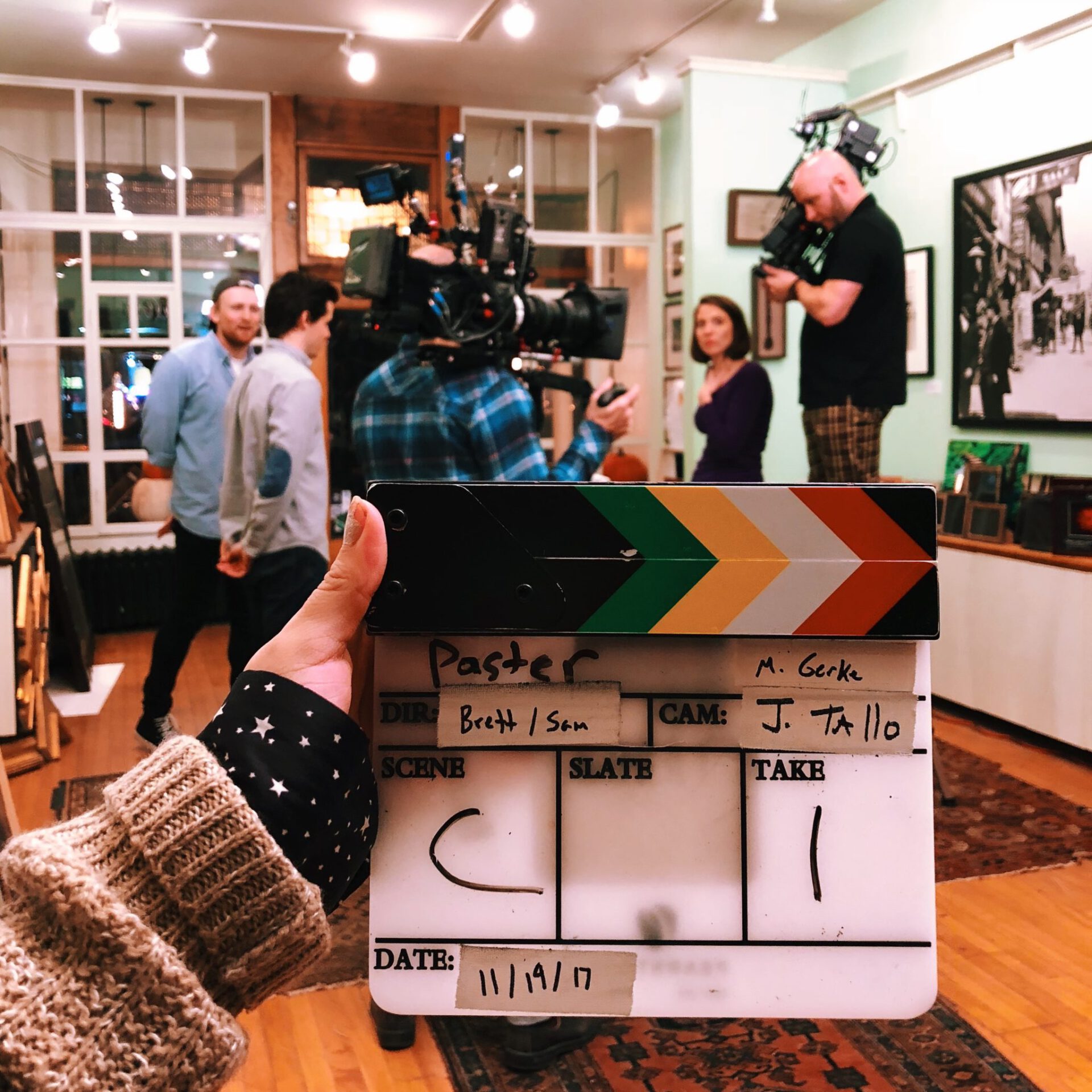
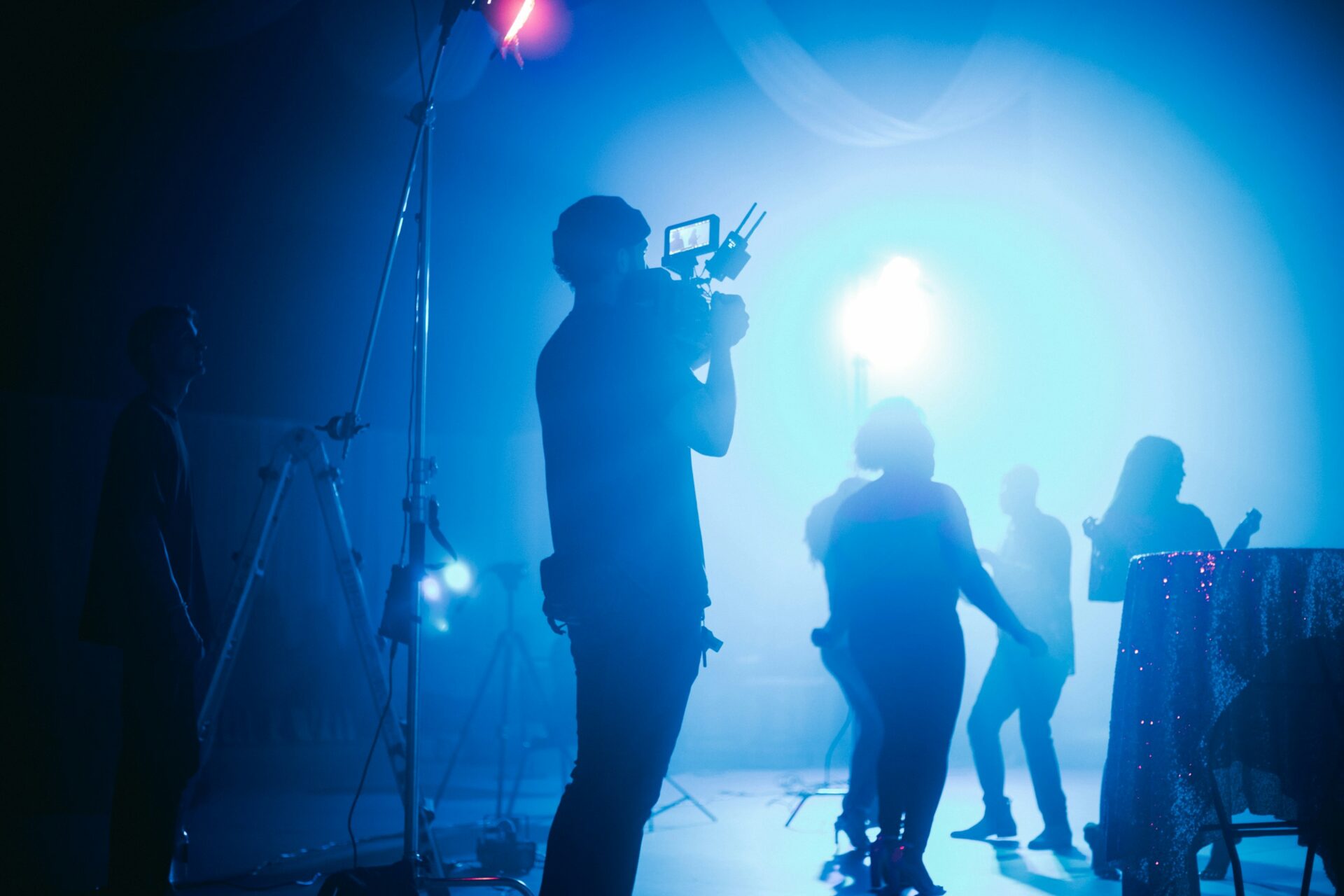
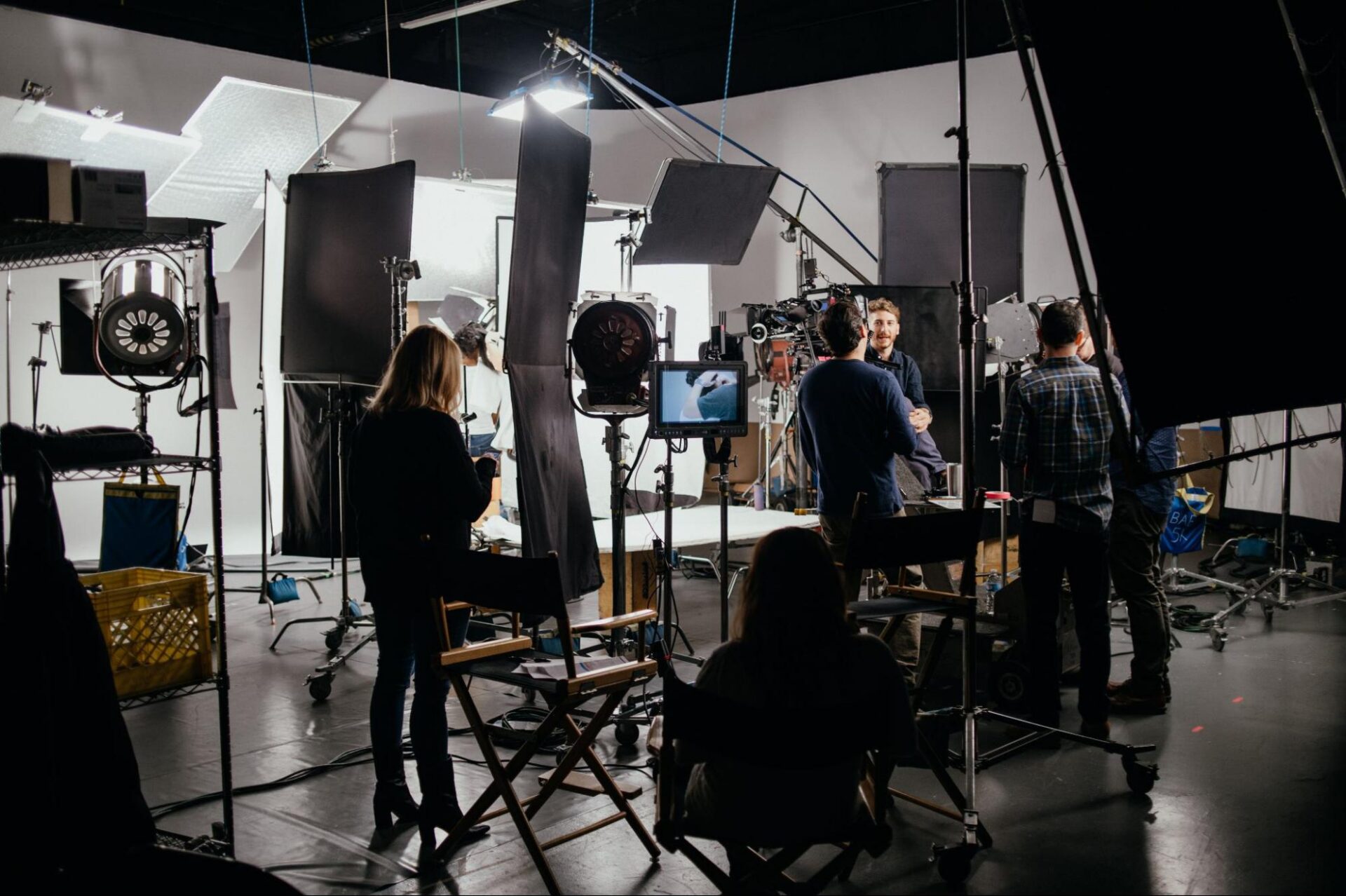
When it is time to shoot, real people are on set. A director who can read the room. Camera operators who know when to hold a shot. A producer managing a hundred details so talent can focus on performing.
This is the part of the process that can’t be replicated, not because of sentiment, but because it’s where authenticity is captured.
Unscripted moments, genuine reactions, and lines that go beyond the script are what bring depth and make the work resonate.
AI can assist in pre-production and post, but when the camera rolls, it must step aside. The one exception is virtual production. If you’re considering using this technique, check out this blog to learn about virtual production and its benefits.
Post-Production:
This is where AI earns its keep inside our professional workflow.
- Transcription: AI tools help to generate accurate transcripts of all interview footage within minutes of the shoot. This used to take days.
- Rough cut assembly: AI-assisted tools can quickly flag the strongest moments in hours of footage, high-energy sections, emotional peaks, and the best takes. We do use AI here, but we also have a team member review footage too.
- Dialogue cleanup: AI removes background noise, AC hum, and room reverb from on-location audio.
- Captions and subtitles: Auto-generated captions in multiple languages, reviewed and corrected by a human editor before anything ships.
- B-roll gap-filling: Adobe Premiere’s Generative Extend fills brief gaps in footage without reshooting, so we may extend a shot by a few frames when needed.
- Color grading assistance: AI-powered color matching tools help maintain a consistent look across footage.
A Quick Reference: AI vs. Human in Video Production
| Task | Best for Output | Why |
|---|---|---|
| Script research & first draft | AI | Fast, broad, efficient |
| Creative direction & strategy | Human | Requires judgment & brand knowledge |
| Storyboards & mood boards | AI + Human | AI generates, humans refine |
| On-camera filming & directing | Human | Authentic emotion, real moments |
| Customer testimonials | Human | Authenticity is the entire point |
| Executive communications | Human | Credibility requires accountability |
| Transcription | AI | Fast, cheap, accurate |
| Rough-cut editing (interviews) | AI + Human | AI speeds it up, humans shape it |
| Captions & subtitles | AI | Near-instant, highly accurate |
| Color grading | Human + AI assist | Final quality requires a trained eye |
| Sound design | Human + AI assist | Emotional nuance matters |
| Voiceovers (internal/training) | AI | Cost-effective at scale |
| Voiceovers (brand/customer-facing) | Human | Connection requires real voice |
| Social media clip creation | AI | Repurposing at scale |
| Brand films & storytelling | Human | No AI can live your story |
| Event & live video coverage | Human | IRL (in real life) requires real judgment |
Now that you know where AI fits, check out this article for a deeper look at the benefits AI brings to the video production process.
Is AI Video Production Cheaper?
Yes, but only in specific use cases where speed and volume matter more than quality and brand impact.
AI video tools can be effective for bulk content like social media reels, simple explainers, ad variations, or AI-generated channels. In these scenarios, they can reduce production time and offer lower-budget options.
That said, AI isn’t inherently “cheaper.” It’s only more cost-effective when the goal is to produce lower-budget content, just like any traditional production approach. If you’re aiming for high-quality, brand-defining work, the idea of AI as a low-cost replacement quickly falls apart.
AI doesn’t bring professional seniority, creative judgment, or the ability to read a moment and direct in real time. It doesn’t build connection. It can generate, assist, and support, but it can’t lead the process or determine what actually makes a video resonate.
There’s also a cost structure people often overlook. AI isn’t “generate and done.” Most tools operate on subscription or credit-based systems, where each iteration requires time and resources. You generate, refine prompts, adjust outputs, fix inconsistencies, and re-render scenes. That process adds up quickly.
On top of that, raw AI output is rarely production-ready. It often requires editing, compositing, sound design, and refinement to reach a professional standard. So while you may not be hiring a full production crew, you’re still investing in time, tools, and expertise to get it there.
And time is costly.
So yes, AI can support lower-budget production. But the real question is whether the result is actually impactful. Does it connect? Does it build trust? Does it move someone to act?
Because if it doesn’t, the true cost isn’t what you saved on production. It’s what you lost in attention, credibility, and long-term brand value.
How Bottle Rocket Media Saves You Money
At Bottle Rocket Media, we use AI to handle the time-consuming parts of production: transcriptions, rough cut assembly, caption generation, music, and even social media reformatting.
A professional video team brings a lot to the table that no AI subscription can replicate: years of production experience, the ability to build a creative strategy from scratch, relationships with on-camera talent, knowledge of lighting and sound, skill in post-production, and an understanding of how a video can actually move people.
AI makes that team faster and more cost-efficient. It does not replace them.
As AI-generated content floods every platform, the brands that show up with real people, real stories, and real production quality are the ones standing out. Not because they are spending more, but because they are being smart about where they invest.
Ready to make a video that actually gets results?
We use AI where it makes sense, to move faster and work smarter, but we never let it replace the human side of storytelling.
Because in the end, your audience isn’t just watching content.
They’re deciding whether they trust your brand.
At Bottle Rocket Media, we help brands turn ideas into videos that perform. From strategy and scripting to video production, motion design, editing, and distribution, we handle the full process so nothing gets lost along the way.
If you want to create a video that actually moves the needle, reach out to us. Let’s build something that works.